How to Calm a Dog With Dementia at Night: What Has Trial Data and What Is a Tip
To calm a dog with dementia at night, rule out pain and a full bladder, then use a fixed evening routine, a night light and a late walk. Selegiline is the only FDA-approved drug, and its best-known result (77.2% of 641 dogs improved, Vet Ther, 2001) had no control group. If nights stay broken, see your vet.
Key facts
| Fact | Value | Source |
|---|---|---|
| When dogs are most unsettled | Over half of 205 owners of dogs aged 8 and older said their dog was most unsettled between 02:00 and 05:00 | The Veterinary Journal, 2026 |
| Selegiline field study | 77.2% of 641 dogs improved at day 60 (67.8% for activity or sleep-wake cycle); open-label, no control group | Veterinary Therapeutics, 2001 |
| Placebo effect in owner scores | A placebo cohort enrolled 21 dogs; the 18 assessed at 6 months improved on average on one owner questionnaire (Hedges g = 0.76) | Geroscience, 2025 |
| Therapeutic diet trial | 87 client-owned dogs, 29 per group, 90 days; the 6.5% MCT diet improved all 6 sign categories, the control diet improved 4 of 6 | Pan et al., Frontiers in Nutrition, 2018 |
| Diets and supplements, overall | A systematic review of trials from 2002 to 2023 found benefits for omega-3 fatty acids, especially at higher doses, and weaker results for vitamins E and C alone | Geroscience, 2025 |
| What vets think works | In a 2025 survey of 318 US vets, selegiline was the most recommended treatment, but only about 30% rated it most effective | Frontiers in Veterinary Science, 2025 |
How do you calm a dog with dementia at night?
You calm a dog with dementia at night by ruling out pain and a full bladder, keeping a fixed evening routine and using a night light. Then ask your vet about medication and diet.
Most common advice has no night-time sleep trial behind it. The sections below mark which options have data and which are practical tips, with the study and its size named wherever a number exists.
Call a vet now if your dog collapses, has a seizure, loses balance suddenly, tilts its head, or struggles to breathe. Slow cognitive decline does not cause those. For breathing that is fast at night, see why an old dog pants at night.
Why is dog dementia worse at night?
Dog dementia is worse at night because it disrupts the sleep-wake cycle, so dogs sleep more by day and pace or vocalize in the dark.
The 2025 working-group guideline lists sleep disruption as one of seven behavior groups (DISHAA). A 2026 survey in The Veterinary Journal asked owners of 205 dogs aged 8 and older about sleep. Over half said their dog was most unsettled between 02:00 and 05:00. Owners of more impaired dogs reported less night-time sleep, more daytime sleep and more trips out at night, though sleep-duration differences between severity groups were not statistically significant. Late-afternoon and early-evening restlessness, the classic “sundowning” pattern, showed an increasing trend with impairment.
The survey is owner-reported, so it shows a pattern, not a cause. The pattern is clear: a 3 a.m. problem is typical of this condition. To confirm the diagnosis, start with the DISHAA signs checklist, and see how the stages progress to know what comes next.
What should an evening routine for a dog with dementia include?
An evening routine for a dog with dementia should fix the timing of the last meal, walk and toilet trip, keep the room lit softly, and make the floor safe to walk on.
Use the checklist below. The last column says what backs each item, so you can judge how much weight to give it.
| Step | What to do | What backs it |
|---|---|---|
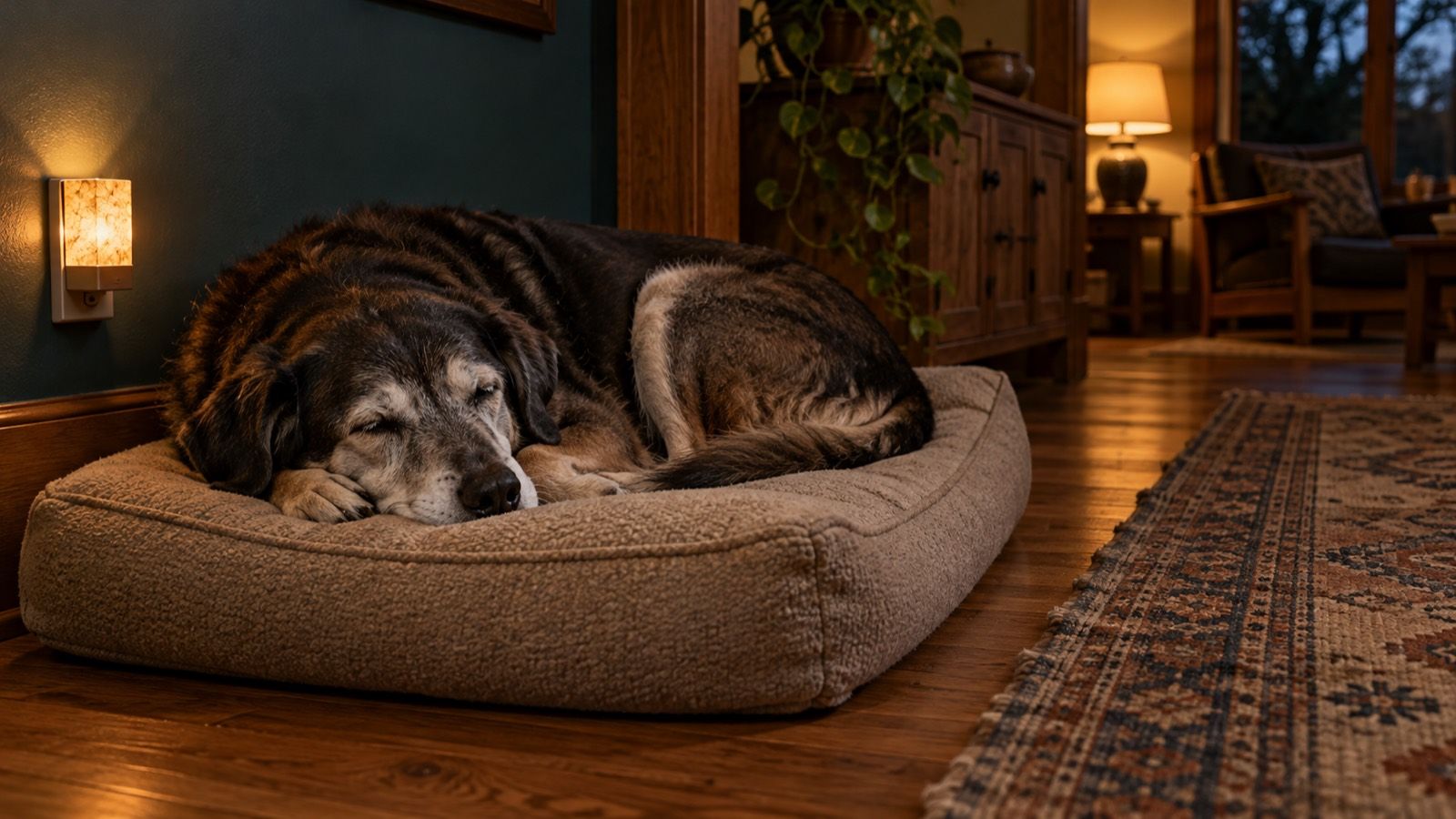
| Light | Leave a low night light on so your dog can see and is less likely to get stuck | Cornell recommends night lights; no trial of sleep effect |
| Timing | Feed, walk and go to bed at the same times each day | Cornell: most senior dogs prefer a set routine for key events; no trial |
| Walk | Take a calm sniff walk before bed, not a hard one | Cornell: an extra bedtime walk may lead to longer, deeper sleep; no trial |
| Toilet | Offer a last trip out just before you settle for the night | Nocturnal elimination rose with severity in the 2026 survey |
| Traction | Put runners or rugs between the bed and the door | Practical tip; no trial |
| Bed and bowls | Keep the bed, water and exits in the same places | Cornell: keep bowls and bed locations unchanged |
| Pain check | Watch whether your dog shifts, pants or cannot settle on a hard floor | Guideline requires other causes be managed first |
Check pain first. The guideline’s first-level diagnosis requires that signs persist after related conditions are managed. If your dog also struggles to stand or its back legs slip, read about back legs giving out and raise it with the vet.
Tonight, write down the time your dog wakes and what it does. Three nights of notes make the vet visit far more useful.
What can I give my dog with dementia to sleep at night?
What you can give a dog with dementia to sleep depends on your vet’s exam, and the options with the best evidence are selegiline and certain diets.
Skip human sleep aids, antihistamines and supplements unless your vet prescribes them. The table lists each option, the study behind it and what that study could and could not show.
| Option | Study and size | Result | Limit |
|---|---|---|---|
| Selegiline (FDA-approved for dementia signs) | Open-label field study, 641 dogs, 60 days (2001) | 77.2% improved overall; 67.8% for activity or sleep-wake | No control group; owner-rated |
| MCT diet with antioxidant blend | Double-blind, placebo-controlled, 87 dogs, 29 per group, 90 days (2018) | 6.5% MCT diet improved all 6 sign categories; control improved 4 of 6 | The 9% MCT diet improved only in dogs that accepted it |
| Omega-3 fatty acids and other supplements | Systematic review of trials from 2002 to 2023 (2025) | Omega-3 helped, more at higher doses; vitamins E and C alone were less effective | Supplement trials were lower quality than diet trials |
| Antioxidant diet plus enrichment | Two-year study in laboratory beagles (2005) | Combined treatment gave more accurate learning than either alone | Lab dogs, learning tests, not sleep |
| Donepezil depot injection | Randomized trial, 32 dogs: 11, 11 and 10 per group, 28 days (2025) | High-dose group improved on three scales vs control | Small, short and a single trial |
| Melatonin | Cornell page | Cornell says little study support | No controlled trial in dogs with dementia turned up in a Europe PMC search on 2026-10-26 |
| Trazodone, rapamycin, CBD | Placebo-controlled TRAC trial at Colorado State | Under way, per a 2026 review | No results cited yet |
Selegiline’s approval status and its trial figures come from the 2001 field study and a 2026 review. Cornell says owners may see change in about three weeks, sometimes six.
How big were the effects, and how much was placebo?
The selegiline result is large on paper, but a 2025 study shows owner scores can improve a lot on placebo alone.
Start with the arithmetic. In the 641-dog study, 77.2% improved: 0.772 × 641 is about 495 dogs, so about 146 did not. Adverse events were logged in a few dogs: diarrhea 4.2% (about 27 dogs), anorexia 3.6% (about 23) and vomiting or salivation 3.4% (about 22). With no control group, the 495 cannot be split into drug effect, placebo effect and natural change.
Now the placebo data. Researchers took 21 dogs from the placebo arm of a randomized trial (18 were assessed at 6 months) and compared them with 17 dogs in an observational study. After 6 months the placebo dogs improved on average on the CADES questionnaire with a strong effect size (g = 0.76, p = 0.021). The observational dogs got slightly worse on a different scale, CCDR (g = 0.35, p = 0.03). Neither group showed statistically significant changes on the dog-based cognitive tests.
The Pan diet trial shows the same pattern. Its control group improved in 4 of 6 categories. So owner-reported improvement can occur without active treatment, and only a controlled comparison shows whether a change was the treatment.
What should I ask the vet about medication?
Ask your vet whether your dog’s night waking has a cause other than dementia, then which option fits, how long to trial it and how you will both judge it.
Bring your notes and these questions:
- Could pain, urinary problems, vision or hearing loss explain the night waking?
- Is selegiline suitable for my dog, and does it interact with anything my dog already takes?
- Would a diet made for cognitive dysfunction suit my dog, given its other health needs?
- What would count as improvement, and when do we recheck?
- Which side effects should make me call you, and what do I stop?
- If a short-term sleep aid is an option, what does the evidence say for my dog?
The 2025 US survey of 318 vets found that selegiline was most often recommended, yet only about 30% of vets rated it the most effective option. Plan a trial period with a set recheck date.
How do you stop a dog with dementia from pacing at night?
You stop pacing by treating its cause: pain, a full bladder, poor footing or confusion, and by making the room safe if pacing continues.
Block stairs and tight gaps where your dog could get stuck. Cornell’s page notes that dogs with dementia can get trapped in corners and behind furniture. Sit with your dog, keep your voice low and walk with it a short way. Never scold. If the pacing looks like circling, read why senior dogs walk in circles. If your dog paces most nights for a week, book a vet review and plan your own sleep.
When should you see a vet about night-time restlessness?
See a vet if the restlessness is new, lasts more than a few nights, comes with pain signs or accidents, or your dog does not respond to the routine.
Book soon. Go the same day for collapse, a seizure, sudden balance loss, a head tilt or hard breathing. Dementia is a diagnosis of exclusion, so even a dog with a known diagnosis needs a recheck when its nights change suddenly.
Frequently asked questions
What can I give my dog with dementia to sleep at night?
Selegiline is the one FDA-approved drug for dementia signs, and diets with medium-chain triglycerides have trial data. Cornell says melatonin has little study support. Skip human sleep aids and antihistamines unless your vet prescribes them.
Why is doggy dementia worse at night?
Dementia disrupts the sleep-wake cycle, so affected dogs sleep more by day and pace or vocalize at night. In a 2026 survey of 205 owners, over half said their dog was most unsettled between 02:00 and 05:00.
How do I stop my dog with dementia from pacing at night?
Check for pain, a need to urinate and poor traction first, since these also cause pacing. Then try a night light, a calm late walk and a set bedtime. If pacing continues for several nights, ask your vet to review medication and diet.
Is sundowning in dogs the same as dementia?
Sundowning describes evening and night restlessness. It is one sign of canine cognitive dysfunction, the sleep-wake group in the DISHAA checklist. Other conditions, including pain and sensory loss, can look the same, so a vet exam comes first.
Does a night light help a dog with dementia?
Yes, make it your first step. Cornell recommends night lights so dogs can see and are less likely to get stuck, and they cost a few dollars. No trial has measured their effect on sleep.
Sources
- The Canine Cognitive Dysfunction Syndrome Working Group guidelines for diagnosis and monitoring of canine cognitive dysfunction syndrome, Journal of the American Veterinary Medical Association (Olby et al.), 2025-12-24 (accessed 2026-10-26)
- Sleep-wake disturbance in canine cognitive dysfunction: Guardian-reported patterns and a practical screening tool, The Veterinary Journal, 2026-08-09 (accessed 2026-10-26)
- Senior dog dementia, Cornell University College of Veterinary Medicine (accessed 2026-10-26)
- A noncomparative open-label study evaluating the effect of selegiline hydrochloride in a clinical setting, Veterinary Therapeutics, 2001 (accessed 2026-10-26)
- Quantifying placebo and trial participation effects on cognitive outcome measures in aging dogs, Geroscience, 2025-08-11 (accessed 2026-10-26)
- Efficacy of a Therapeutic Diet on Dogs With Signs of Cognitive Dysfunction Syndrome (CDS): A Prospective Double Blinded Placebo Controlled Clinical Study, Frontiers in Nutrition (Pan et al.), 2018 (accessed 2026-10-26)
- Enhancing cognitive functions in aged dogs and cats: a systematic review of enriched diets and nutraceuticals, Geroscience, 2025-01-18 (accessed 2026-10-26)
- Learning ability in aged beagle dogs is preserved by behavioral enrichment and dietary fortification: a two-year longitudinal study, Neurobiology of Aging, 2005 (accessed 2026-10-26)
- Current practices for diagnosis and management of Canine Cognitive Dysfunction Syndrome in the United States, Frontiers in Veterinary Science, 2025-10-29 (accessed 2026-10-26)
- Evidence-Based Clinical Management of Canine Cognitive Dysfunction Syndrome: Diagnostic Algorithms, Practical Guidelines, Critical Appraisal of Biomarkers and Translational Limitations, Animals (Basel), 2026-04-04 (accessed 2026-10-26)
- Evaluation of the safety and efficacy of a donepezil depot injection in dogs with canine cognitive dysfunction, Frontiers in Veterinary Science, 2025-12-15 (accessed 2026-10-26)