Dog Sling or Lift Harness for Weak Back Legs?
For weak back legs, use a sling for short lifts and a two-piece lift harness for all-day help. The Dog Aging Project says some hind-end-only aids are temporary, while two-piece harnesses can stay on. A sling is a padded belly band under the back legs. Choose a full-body harness when the front end tires.
Key facts
| Fact | Value | Source |
|---|---|---|
| Hind-end aids and constant wear | Some products that support only the hind end are temporary lifting and walking aids, not intended for constant use; permanent or semi-permanent two-piece harnesses can be left on | Dog Aging Project |
| Who picks the product | The Dog Aging Project recommends contacting your veterinarian to determine the optimal product, style and size for your dog | Dog Aging Project |
| Degenerative myelopathy care | Cornell lists using a sling or harness to assist with walking and standing among the measures for this disease | Cornell Riney Canine Health Center |
| PetSafe CareLift rear harness sizes | Small: waist 12-24 in, 7-35 lb. Medium: waist 19-31 in, 35-70 lb. Large: waist 27-37 in, 70-130 lb | PetSafe |
| Sudden severe weakness | Severe disc disease needs prompt surgery, and recovery chances decrease if surgery is delayed more than 24 hours after pain perception is lost | Merck Veterinary Manual |
| Lifting limits for people | The 1991 NIOSH lifting equation sets lower limits for lifts that twist the body or have a poor grip, and the authors say it was not fully validated | Waters et al., Ergonomics (PubMed) |
What is the difference between a dog sling and a lift harness?
A dog sling is a padded band under the belly or hips that lifts the back legs. Lift harnesses come in rear, front and full-body versions, and a full-body harness supports the chest and hindquarters together.
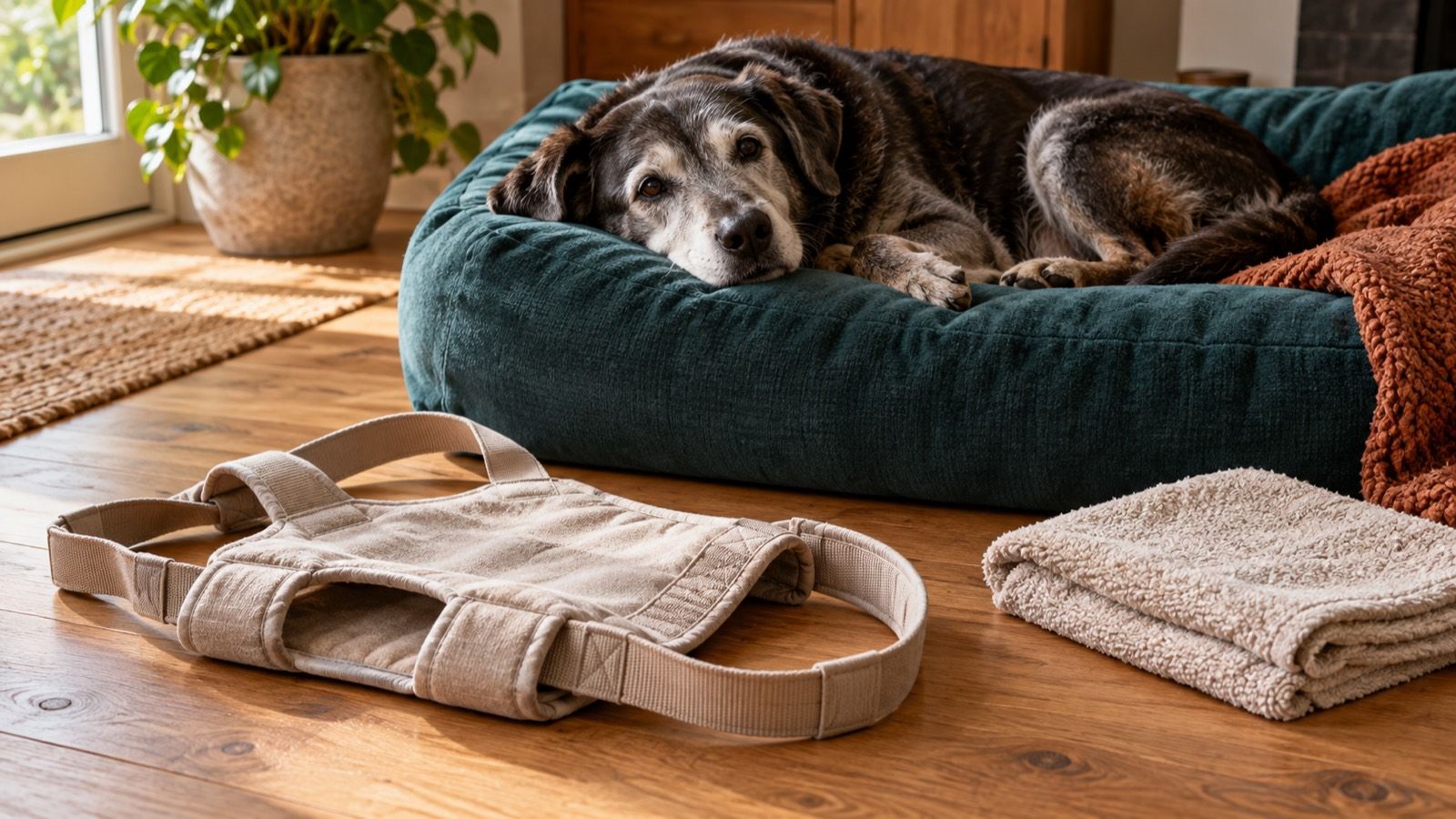
Rear-only products go by several names, including rear support harness, hind-end aid and hip sling. The names overlap, so judge a product by where its straps sit. A band under the belly with two handles is a sling. A rear harness adds leg loops around the thighs. A full-body harness covers the chest and the hindquarters; connectors and handle positions vary by model.
The Dog Aging Project’s mobility guide draws the line that matters for daily use. Some products that support only the hind end are temporary lifting and walking aids, easy on and off but not intended for constant use. Its permanent or semi-permanent harnesses come in two pieces that link together, wrap the front legs and chest and the back legs, and can stay on the dog.
Which is better for weak back legs, a sling or a harness?
For short assists with weak back legs a sling is enough, and a full harness is better when the front legs also tire or you need to carry weight for longer.
The table sorts the common situations that makers such as Mighty Paw list: stairs, the car, toileting and short walks. Wear time follows the Dog Aging Project’s temporary-versus-constant distinction.
| Situation | Rear sling or rear harness | Full lift harness |
|---|---|---|
| Getting up from a lying position | Good. Lift the hips and let the front legs push | Good, and steadier for a dog that wobbles at the front |
| Stairs, a few steps | Good. Handles close to your body, you climb behind or beside | Good. Support at chest and hips; handle positions vary by model |
| Getting into a car | Works for small and medium dogs | Better for large dogs, because you can lift front and back |
| Squatting to toilet | Good. Belly strap must sit clear of the genitals and not press the bladder area | Check the model’s toileting clearance and instructions |
| Short walks on a slip-prone floor | Good | Good |
| All-day wear | Some are temporary aids, per the Dog Aging Project | Two-piece harnesses can be left on, per the Dog Aging Project |
| Progressive weakness (such as degenerative myelopathy) | Fine early on | Likely needed later, as the front legs tire |
| Front legs also weak or dog cannot bear any weight | Not enough | Needed |
Cornell lists a sling or harness among the care measures for degenerative myelopathy, along with physical therapy, ramps and a wheelchair. It does not say which to start with. Your vet or a rehabilitation therapist can.
See a vet first if the weakness is new. Merck says severe disc disease needs prompt surgery and that recovery chances fall if surgery is delayed more than 24 hours after pain perception is lost. Merck also warns that more activity can push a disc out further. Do not lift a dog with sudden weakness or back pain until it has been examined. Our guide to back legs giving out lists the causes and what to tell the vet.
How do you measure a dog for a back leg sling or rear harness?
Measure the belly or waist just in front of the hind legs, and the weight, then compare both with the maker’s chart.
Makers use different measuring points, so read each chart before you buy. PetSafe, for instance, sizes its CareLift rear harness by waist and weight. Its size chart publishes a size diagram for the waist measurement, so check the diagram.
- Stand your dog on a non-slip floor. A second person can steady the front end.
- Run a soft tape around the belly just in front of the hind legs. Keep it snug, not tight.
- Write the number in inches and centimeters. Weigh your dog on a home scale (hold the dog, then subtract your own weight) or at the vet.
- Compare both numbers with the chart. If they point to different sizes, ask the maker or your vet before ordering.
Worked example using PetSafe’s published chart (Small: 12-24 in waist, 7-35 lb. Medium: 19-31 in, 35-70 lb. Large: 27-37 in, 70-130 lb):
| Dog | Waist | Weight | Result |
|---|---|---|---|
| Dog A | 22 in (56 cm) | 28 lb (12.7 kg) | Small. Waist fits Small and Medium, weight fits only Small |
| Dog B | 26 in (66 cm) | 50 lb (22.7 kg) | Medium. Waist fits Medium, weight fits only Medium |
| Dog C | 18 in (46 cm) | 45 lb (20.4 kg) | Conflict. Waist fits only Small, weight fits only Medium. Ask the maker |
The published waist ranges overlap, so a dog can fit two sizes by waist. Dog C’s waist and weight fall into different sizes, so the chart alone cannot settle the choice. Ask the maker.
How do you make a towel sling for a dog?
Fold a bath towel lengthwise and pass it under the dog’s belly in front of the hind legs, or cut open a sturdy tote bag, and hold the ends or handles.
The MSPCA’s method uses a strong reusable fabric or heavy plastic grocery tote with sturdy, well-attached handles:
- Stand the bag upright.
- Cut down the middle of each side, top to bottom, so the bag opens flat.
- Check that it lies flat.
- Slide it under the dog’s lower belly and gently support the dog by the handles.
For a towel, fold it lengthwise into a band about as wide as your hand is long and pass it under the lower belly. Hold both ends together on top of the back.
A towel has no fit adjustment and can bunch under load, so use it for toileting or a few steps. For daily help, move to a fitted sling or rear harness.
How do you lift a heavy dog without hurting your own back?
Keep the dog close, lift with bent knees, take only part of the weight and stop when the dog can steady itself.
The Revised NIOSH Lifting Equation is the standard workplace tool for safe lifting. Its 1993 documentation says the 1991 equation gives lower limits for lifts that twist the body, and for lifts with a poor grip. The authors also say it was not fully validated. It was not built for a living load that shifts, so use it as a reason to keep the dog close, not as a number for your dog.
- Set the handles so you can stand tall. Stooping is what strains the back.
- Support the hips, do not hoist. The front legs should still do their share.
- Take stairs one step at a time and pause on each landing.
- For a large dog in a car, use a ramp or ask a second person. Our ramp vs stairs guide shows which suits your dog.
- If you need to bear most of the dog’s weight each day, ask your vet about a full harness, a wheelchair or a different plan.
Which lift harness should I buy?
Match the product to the situation table, then confirm the size with the measuring steps above and the maker’s chart. The Dog Aging Project recommends contacting a veterinarian to determine the optimal product, style and size. A rehabilitation vet can fit a harness in person and show you how to lift. For other home changes that help a dog with weak back legs, start with the senior dog guides, and see dog arthritis treatment if stiff joints are behind the weakness.
Frequently asked questions
How do you lift a dog with hind leg weakness?
Slide a sling or rear harness under the belly or hips, keep the handles close to your body, bend your knees and lift only enough to take weight off the back legs. The dog's front legs should still walk. If the weakness is sudden or your dog cries out, call a vet before lifting.
Can a dog wear a rear support harness all day?
Usually not. The Dog Aging Project describes some hind-end-only aids as temporary and not intended for constant use, and says its permanent two-piece front-and-back harnesses can be left on. Follow the wear instructions for your model, and ask your vet which style suits your dog.
Can I make a towel sling for my dog?
Yes, as a short-term fix. A folded towel or a cut-open sturdy tote bag can be passed under the belly and held by its ends or handles. It has no fit adjustment, so expect it to bunch. For daily help, buy a fitted sling.
Why do dog trainers not recommend harnesses?
Walking harnesses and mobility-support harnesses serve different purposes. Support slings and lift harnesses assist a dog that cannot stand or climb well. Your vet or a rehabilitation therapist can show you how to use one.
Sources
- Mobility tips and tricks for senior dogs, Dog Aging Project, 2021-03-18 (accessed 2026-10-26)
- Degenerative myelopathy, Cornell Riney Canine Health Center (accessed 2026-10-26)
- PetSafe CareLift Rear Support Harness, PetSafe (accessed 2026-10-26)
- Disorders of the spinal column and cord in dogs, Merck Veterinary Manual (accessed 2026-10-26)
- How to make a supportive dog sling, MSPCA-Angell (accessed 2026-10-26)
- Revised NIOSH equation for the design and evaluation of manual lifting tasks, Ergonomics (Waters, Putz-Anderson, Garg, Fine), 1993 (accessed 2026-10-26)
- Dog lift harness for 4 daily activities, Mighty Paw, 2022-05-23 (accessed 2026-10-26)